
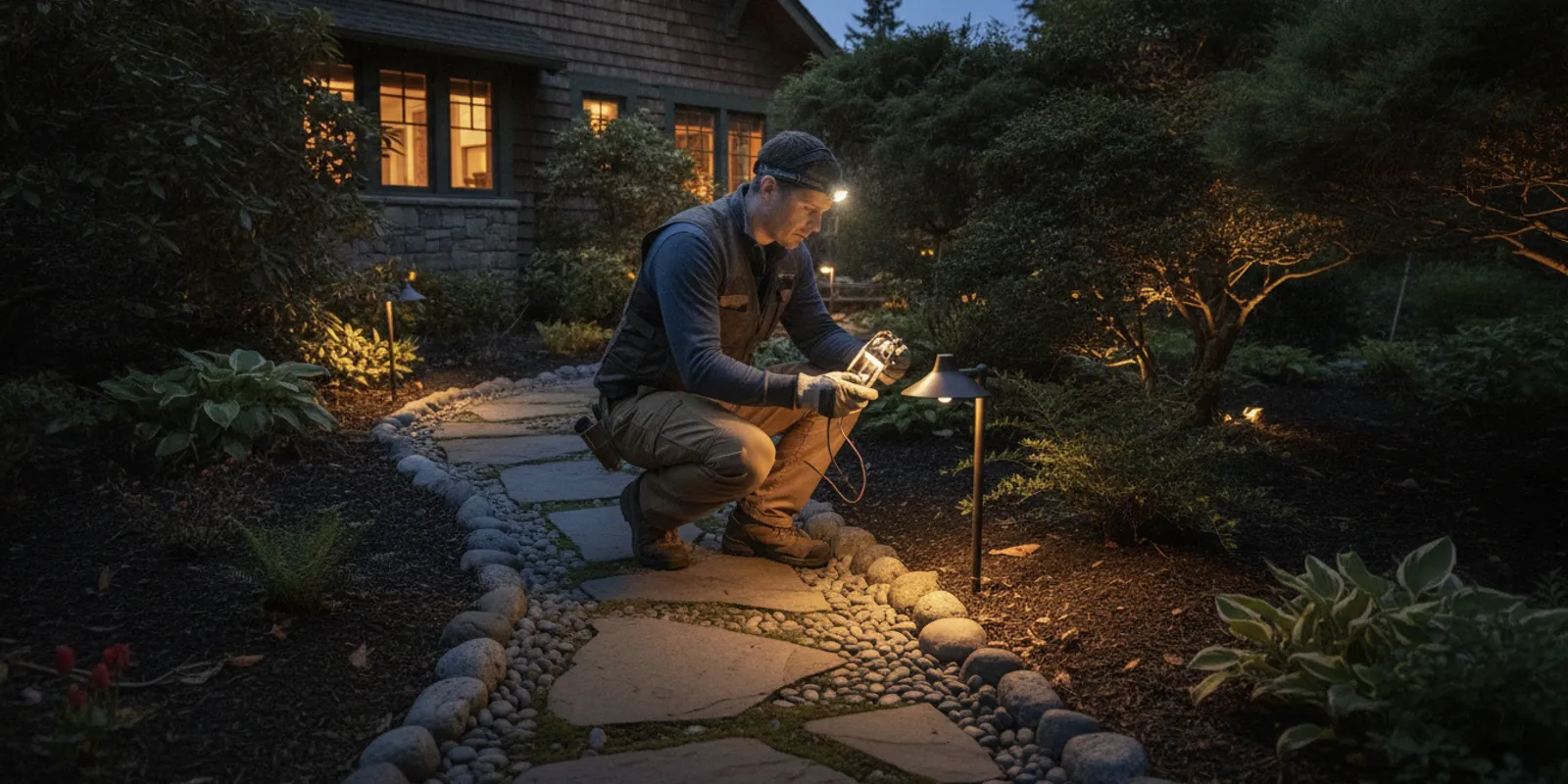
Landscape lighting repair cost is shaped by what has failed, how the system is wired and controlled, and how much troubleshooting is needed to identify the cause. A dark fixture may be a simple lamp issue, but it can also point to a wiring fault, a control setting or a problem affecting several parts of the system. There is no reliable one-size price for every repair. A site review helps identify the fault and describe the work in an itemized proposal.
Request a landscape lighting service consultation
Why does landscape lighting repair cost vary?
A repair visit is not just a matter of swapping a fixture. The visible symptom and its cause are not always the same. One light that flickers could have a lamp or connection issue, while a group of lights going dark could involve a shared wire, transformer output or control setting. A technician needs to determine whether the proposed fix addresses the underlying problem.
Several factors can change the scope:
- The fault: A failed lamp, loose connection, damaged cable, moisture-related issue or control problem calls for different diagnostic and repair steps.
- How much of the system is affected: One fixture is different from a whole zone or multiple areas that share a circuit or control.
- Fixture and transformer condition: Existing equipment may be repairable, may need a component, or may be near a point where replacement should be considered.
- Access: Wiring beneath planting, hardscape, edging or established lawn can take longer to locate and reach than accessible wiring.
- Troubleshooting time: Intermittent failures and symptoms that change when the system warms up or when a control schedule runs may take more testing.
- Controls and system layout: Timers, zones, app settings and other control components can be part of the diagnosis.
- Recommended additional work: A repair may reveal related deterioration or a design issue that affects reliability and should be documented separately.
These factors are why a price should follow review of the actual system and the requested work. A photo or a short description can help explain the symptom, but it does not establish the condition of concealed wiring or equipment.
What symptoms are useful to describe?
Before arranging service, note exactly what the lights are doing. “The yard lights are out” is a useful start, but a little more detail can help focus the inspection. Record which fixtures or areas are affected and whether the issue is constant or intermittent.
- Are all fixtures off, or only a few?
- Do the affected lights belong to one area or appear scattered across the property?
- Do the lights flicker, dim, turn on late or shut off unexpectedly?
- Does the problem happen every evening or only under certain weather or schedule conditions?
- Have you noticed a recent change to landscaping, irrigation, construction or outdoor electrical equipment near the affected area?
- Are any controls, timers or app settings difficult to access or behaving differently than expected?
Do not dig around a suspected cable or open electrical equipment to investigate. Instead, share the observations with the service team and point out any known changes to the property. If the system serves a commercial site or managed property, note who can provide access and who is authorized to approve work.
Photos taken from a safe distance can help show which fixtures are affected and how they relate to paths, beds or hardscape. They do not replace testing, but they may provide context before a visit. If you can identify the transformer or control location without opening anything, mention where it is. Avoid guessing about the cause; describe what you see.
How does the fault affect the repair scope?
Different faults can produce similar nighttime symptoms. A single dark lamp may be relatively straightforward to diagnose, but multiple dark fixtures can require tracing the system back through a zone. The repair scope depends on confirming what failed rather than assuming that the most visible part is the only problem.
One fixture is dark
When one fixture is out, the technician may check the lamp or LED module, fixture connections, nearby wiring and the condition of the fixture itself. If the fixture is damaged or water has affected components, replacing only a lamp may not address the cause. The proposal should distinguish the inspection from any recommended part or fixture replacement.
Several fixtures in one area are out
A group of fixtures that fails together may share a branch, connection, zone or control. Diagnosis can involve checking the points that serve that group and tracing the circuit as needed. The layout matters: a clear, accessible run is different from a cable route concealed under mature planting or a finished surface.
The whole system is off
If all lights are dark, the review may include the transformer, incoming power conditions, timer or control settings, and connections between the equipment and the lighting runs. The fault may be at a common point, but that should be verified. A system-wide symptom does not automatically mean the transformer has failed.
The problem comes and goes
Intermittent failures can require more observation and testing than a stable failure. A loose connection, changing control schedule, moisture exposure or component that behaves differently under load may produce symptoms that are hard to reproduce. Tell the technician when the problem occurs and whether any recent setting changes coincide with it.
For a broader look at care and troubleshooting decisions, see outdoor lighting support and repair considerations. That discussion can help frame the difference between a one-time fault and a system that may need ongoing attention.
How do fixture and transformer condition matter?
A fixture is exposed to soil, water, temperature changes, landscape work and routine use. Its age and condition can affect whether a repair is practical. During review, the technician may look at the housing, lens, mounting, connections and light output, then explain whether the existing fixture appears suitable for continued use or whether replacement merits consideration.
The transformer is another important part of the system. Its capacity, output, connections and controls need to be considered in relation to the lighting it serves. If additional fixtures have been added over time, or if the system has changed, the original arrangement may no longer tell the whole story. Testing can help distinguish a transformer-related fault from wiring or control issues elsewhere.
Replacement should be based on observed condition and the desired outcome, not an automatic assumption that all older equipment must be removed. A useful proposal can explain the reason for a recommended part, whether the existing component can remain in service, and what the alternatives mean for the system. If the repair is limited, keep that scope separate from optional upgrades.
For property owners considering a larger update rather than a repair alone, CLG describes landscape lighting as a property-specific design and installation service. Landscape lighting projects have a minimum project value of $5,000. This is distinct from an individual repair visit, and a repair inquiry does not mean that a full redesign is required. Discuss the condition and goals with the team before deciding whether repair, replacement or broader work makes sense.
Why can wiring access change the service visit?
Low-voltage wiring may follow routes that are not obvious from the surface. It can run through planting beds, beneath turf, alongside a path or around landscape features. When the fault is in an accessible connection, inspection can be more direct. If the likely route passes under hardscape, dense roots or established plantings, locating and reaching it can require additional steps.
Property conditions can also influence how work is approached. A recently renovated bed, new paving or irrigation work may have changed access or disturbed a cable. On commercial and HOA properties, restricted areas, tenant activity and permission requirements can affect when and how the system can be inspected. Share these constraints in advance so the scope can account for them.
Careful access matters. The aim is not simply to reach a cable quickly, but to identify the affected section and avoid unnecessary disturbance to the surrounding landscape. Ask what area may need to be accessed, what restoration is included or excluded, and whether the proposal assumes that a particular route is available. These details help set expectations before work begins.
Do not assume that a visible fixture is directly above its wire run. Nor should you cut, pull or splice buried cable yourself. A qualified review can locate the problem and explain the repair approach. If excavation or surface restoration may be involved, request that the proposal identify those assumptions clearly.
How do controls affect diagnosis?
Controls can determine when fixtures operate, which areas turn on together and how a system responds to schedules or manual commands. A light that appears to have failed may instead be affected by an incorrect schedule, a control setting or a zone configuration. Conversely, a control issue can coexist with a fixture or wiring fault.
Useful details include whether the system uses a timer, app, photocell or more than one control method; which zones are affected; and whether a recent setting change preceded the problem. If an app is used, note the device or control name and any message displayed. Do not reset everything before the visit if that would erase information that helps explain the symptom.
A review can check whether the control behavior matches the intended operation and whether the equipment is responding consistently. If a repair proposal includes control changes, ask what will change, whether scenes or schedules need to be reconfigured, and who will confirm operation after the work. This is especially useful for properties where different areas have distinct uses or operating hours.
Controls should be considered in context rather than treated as a separate add-on by default. A straightforward setting correction may be different from replacing a failed control component or revising zone logic. An itemized scope makes that distinction visible.
What does troubleshooting time include?
Troubleshooting is the process of narrowing down a symptom to a cause. It may include inspecting fixtures, testing connections, checking equipment and controls, and determining which part of the system is affected. The amount of time can vary with the number of fixtures, how the system is divided into zones, whether the fault is intermittent and how accessible the wiring is.
Older systems may have changed through additions or repairs over the years. Labels may be missing, fixtures may not match, and wiring routes may not be documented. A technician may need to establish how the system is arranged before deciding what repair is appropriate. That investigation is part of reaching a defensible scope, not proof that every component must be replaced.
Ask whether the proposed service includes diagnosis, the specific repair, testing after the repair and any follow-up recommendation. If the cause cannot be confirmed until a component is accessed, ask how that uncertainty will be handled. The team should explain what is included in the proposed work and seek approval before expanding scope.
When several possible causes remain, a good next step is a clearly described diagnostic visit rather than a guessed price for a presumed fix. The result can establish what is known, what still needs testing and whether repair or replacement is the practical path. A site review and itemized proposal give both parties a common reference point.
How should you compare repair and replacement?
Repair and replacement are not interchangeable answers. Repair may preserve a functioning fixture or system component when the fault is limited and the surrounding equipment remains suitable. Replacement may be worth considering when a component is damaged, incompatible with the system or unlikely to support the desired performance. The appropriate choice depends on the inspection, the owner’s goals and the scope of the system.
Consider these questions when reviewing recommendations:
- What specific fault has been identified, and what evidence supports that diagnosis?
- Which components will be repaired or replaced?
- Will the proposed work address the underlying cause or only the visible symptom?
- What existing parts will remain, and have they been checked as part of the review?
- Is there an alternative that keeps the repair narrower, and what trade-offs should be understood?
- Will the work change fixture placement, light distribution, controls or the appearance of the scene?
- What testing will confirm that the affected area operates after the work?
If replacement is recommended, ask why the existing part is not a suitable repair candidate. If repair is recommended, ask whether any related condition should be monitored. Neither answer should be treated as universal; the purpose of the review is to match the work to the actual system.
For example, a single damaged fixture in an otherwise serviceable run may call for a focused repair. A set of recurring failures across several areas might lead to a broader diagnosis of wiring, connections, controls or equipment condition. These are illustrative situations, not a prediction of what a particular property will need.
What should an itemized proposal explain?
A proposal should make the recommended work understandable before you approve it. It can separate the diagnosis from parts and labor, show which fixtures or zones are involved, and identify any access assumptions. If replacement or additional improvements are optional, those should be distinguishable from the work needed to address the reported fault.
Look for clarity on:
- Observed issue: The symptom and the area or equipment reviewed.
- Recommended action: The repair or replacement being proposed and why it addresses the diagnosis.
- Parts and components: The fixtures, lamps, connections, transformer components or controls included, where applicable.
- Access and property care: The areas that may be disturbed and any assumptions about access or restoration.
- Testing: How operation will be checked once work is complete.
- Exclusions and unknowns: Conditions that could not be confirmed before access, plus the process for asking approval if scope changes.
- Service support: How to report a concern after the visit and what written terms apply.
Warranty and service terms should be read as written for the specific work. Manufacturer coverage for a component is not automatically the same as labor or workmanship coverage by an installer. Ask which written terms apply rather than assuming a broad promise based on a product description.
CLG provides consultations and written estimates for property-specific projects. A repair proposal should be human-reviewed and based on the observed scope, not a generic published flat rate. If the issue is not yet diagnosed, ask what the first visit is intended to establish.
How can you prepare for a service consultation?
A little preparation can make the conversation more useful without requiring you to diagnose the system. Gather a short record of the symptoms and any known changes. If you manage a larger property, identify the person who can authorize access and explain the priority areas.
- Map the affected area. Mark which fixtures are out, flickering or behaving differently. A simple hand-drawn plan is enough if you do not have a lighting layout.
- Record when it happens. Note the date, time, weather if relevant and whether the condition is continuous or intermittent.
- Describe the controls. Mention timers, app operation or zones you know about, along with recent setting changes.
- Share recent site work. Point out landscaping, paving, irrigation or construction that may be near the wiring path.
- Clarify your goal. Say whether you want the immediate fault corrected, a broader system review, or advice on a future update.
- Plan for access. Identify gates, restricted areas, pets, operating hours or property-management approvals that could affect the visit.
These notes help direct attention, but the technician still needs to inspect and test the system. Be clear about what you have observed and avoid presenting a suspected cause as a confirmed diagnosis. If you have an old proposal, system plan or service record, share it if available.
For ongoing maintenance or a concern that may extend beyond one fixture, the guide to landscape lighting in Oregon provides additional context about planning a system around the property. For pathways specifically, see Oregon pathway lighting considerations.
How do homeowners and property managers approach repairs?
The basic diagnosis is the same, but access, priorities and approvals can differ. A homeowner may be focused on a dark entry, a garden feature or an area used for evening entertaining. A commercial property manager may need to coordinate tenants, document affected zones and arrange work around business hours. An HOA or multi-property manager may have approval requirements and a need to keep a consistent record across sites.
Before work is scheduled, make sure the person requesting service has authority to approve the scope. For a managed property, explain who will review the proposal, how access will be provided and whether the work needs to happen during a specific window. If there are multiple systems or buildings, specify the exact location of each reported issue.
Prioritize based on actual use and the condition found, not on a blanket promise that every fixture can be restored in one visit. A team can explain what is known after review and whether parts or additional access are needed. If an urgent operational concern exists, describe it plainly so the scope can be discussed; do not assume a guaranteed response time.
For homeowners, it may be useful to separate the immediate repair from later design improvements. For managers, separating corrective work from optional upgrades can help keep approvals and records clear. In either case, an itemized proposal helps show what is necessary now and what could be considered separately.
What common assumptions should you avoid?
- Assuming one dark fixture means one failed lamp. The fault may be at a connection, control or other point in the system.
- Assuming all dark fixtures need replacement. Testing may identify a limited repair instead.
- Assuming the transformer is the cause. A system-wide symptom has several possible explanations.
- Assuming access is simple. Concealed wiring and established landscaping can affect diagnosis and repair.
- Assuming a quoted number applies to every property. System layout, parts, controls and troubleshooting differ.
- Assuming an upgrade is required to fix a fault. Ask which elements are essential to the proposed repair and which are optional.
- Assuming a component warranty covers all work. Check the specific written coverage for parts and labor.
- Assuming a symptom identifies its cause. Describe the symptom and let testing establish the diagnosis.
A dependable service conversation is transparent about what is known and what still needs inspection. It should not promise the same outcome or charge for every property before the system has been reviewed.
What can different repair scenarios look like?
Examples can help explain why a service estimate should be tied to findings. They are not price quotes or predictions. The same symptom may have a different cause on another property, and two similar-looking systems can have different wiring routes, fixture types and controls.
A single path light stops working
Suppose one path fixture is dark while the fixtures before and after it still operate. The first question is whether the fault is confined to the light itself or whether a connection along the run is affected. Inspection may focus on the fixture, its lamp or module, the connection and the nearby cable. If the fixture housing is intact and the fault is a replaceable component, the work may stay narrow. If the housing is damaged or the connection has been affected by water or soil conditions, the recommended scope could differ.
For this situation, useful proposal details include the exact fixture location, what was tested, which part is proposed for replacement and whether the surrounding run was checked. If a replacement fixture is recommended, ask whether its size, finish and light output are intended to match the rest of the path. If matching equipment is unavailable or a change is proposed, that should be explained before approval.
A whole zone turns off at once
If a set of fixtures goes dark together, the investigation may look at shared components and the zone’s wiring and controls. The technician needs to establish whether the group actually shares a circuit or whether the apparent pattern is coincidental. A transformer, connection, control setting or cable fault may be among the possibilities, but the symptom alone does not confirm any of them.
In this case, a property sketch showing which fixtures failed can be more helpful than a general description. Note any fixtures in the same area that still work. If the lights use distinct zones or a controller, describe how those zones are intended to operate. A proposal can then state which points were inspected and whether further tracing or access is necessary.
A system flickers only sometimes
Intermittent problems can be frustrating because the system may appear normal during a visit. A dated record of when the flicker occurs can help identify a pattern. Include whether it happens at startup, after the lights have been on for a while, during a particular control schedule or after rain. These observations are clues, not a substitute for diagnosis.
Ask what testing can be performed while the symptom is present and what additional information would be useful if it cannot be reproduced. It may be reasonable for the first step to establish a likely cause, with repair work proposed afterward if more testing or parts are required. The scope should make clear whether the initial visit includes a repair or is diagnostic only.
A fixture is physically damaged
A fixture that has been struck by a mower, shifted by settling soil or affected during landscaping may need more than an electrical check. The installer may need to assess its mounting, housing, connection and alignment, as well as the condition of the surrounding surface. If the light is still operating but points in the wrong direction, the issue may be positioning rather than a failed electrical component.
Tell the service team about known impacts or nearby work. Do not conceal a damaged fixture by pushing it into the soil or attempting to straighten wiring. A clear description helps the technician consider whether the repair should include remounting, part replacement or review of the adjacent area.
A previous repair did not last
If the same area has failed more than once, share the timing and details of the earlier work. A repeat symptom can indicate that the underlying cause was not resolved, that another component has failed, or that conditions at the site are affecting the system. It does not automatically mean the entire installation needs replacement. Reviewing available records can prevent unnecessary repetition and help the team understand what was already changed.
Ask the reviewer to distinguish a recurring condition from a new failure and to explain what evidence points to the recommended next step. Keep prior invoices, written scopes or notes if available. This history is particularly helpful when a property has changed hands or several contractors have worked on the lighting.
How can you plan around access and property care?
Repair work takes place within a lived-in or actively managed landscape. The access plan should account for plants, irrigation, paths, outdoor furniture, pets and business operations. Before the visit, point out delicate planting, recently installed surfaces and locations where digging or equipment movement is restricted. The goal is to make the work area clear without asking an owner to disturb wiring or fixtures.
For residential properties, consider whether gates will be unlocked and whether someone needs to be present to explain the layout. Move movable items only where convenient and safe. If an area cannot be accessed, say so before the visit; a technician can then clarify whether the review can proceed or whether another arrangement is needed.
For a commercial site, consider customer and staff circulation, deliveries, operating hours and any site-specific rules. A manager may need to notify tenants or arrange an escort. For an HOA or multiple properties, identify the exact address or common area and the person who can approve work. These practical details do not determine the technical cause, but they can affect the sequence and scope of a visit.
Discuss restoration expectations if the likely cable route passes through turf, planting or a finished area. Ask what surface disturbance is anticipated and what the proposal includes afterward. Do not infer that every repair includes landscape restoration unless the written scope says so. Similarly, if access reveals a different issue than expected, ask for the revised scope and approval process before additional work proceeds.
What should you ask before approving work?
A short set of questions can make the decision clearer. The aim is not to challenge every technical detail, but to understand what the proposal will accomplish and how changes will be handled.
- What did the inspection establish about the cause of the failure?
- What parts of the system were tested, and what could not be inspected?
- Does the proposal include diagnosis, repair, replacement, or some combination?
- Which fixtures, zones or control components are included?
- Could access conditions change the work, and how will that be communicated?
- Will the proposed repair preserve the existing lighting layout and appearance?
- What testing will be completed, and how will the result be explained?
- Are recommended improvements optional, or necessary to address the reported problem?
- What written terms govern parts, labor and any follow-up?
- Who should be contacted if the symptom returns or a concern arises?
For managed properties, add questions about approval authority, tenant communication and access windows. For a homeowner planning other outdoor work, ask whether the repair should be coordinated with landscaping or paving so the cable route is not disturbed again. Keeping the conversation specific helps prevent assumptions on both sides.
It is reasonable to ask for alternatives when the diagnosis supports more than one approach. A focused repair and a broader refresh may have different objectives. The proposal should explain the trade-offs without implying that a larger project is automatically necessary. Any broader landscape lighting project should be scoped separately from the repair question and follow the stated $5,000 minimum project value.
When is a broader system review worth discussing?
A repair visit may reveal that the issue is not isolated. Several mismatched fixtures, repeated connection problems, inconsistent zones or controls that no longer match how the property is used can make a broader review useful. This does not mean a redesign is required. It means the owner may want a clear picture of the system’s condition and priorities rather than addressing each symptom without context.
Consider a broader review when multiple areas have recurring issues, when the system has been expanded without a current plan, or when a property has changed in ways that affect nighttime use. A new patio, renovated entry or altered planting bed may change where light is useful. In those cases, clarify whether the immediate repair can be completed independently and what a separate design discussion would cover.
A practical review can separate urgent corrections, routine upkeep and optional improvements. For example, restoring a dark entry area may be one priority, while adjusting a garden feature or adding a new zone may be a future choice. Property owners and managers can then evaluate the work in stages, with each stage described and approved on its own terms.
Do not treat a system review as a promise of a particular result or as a substitute for a written scope. Ask what areas will be inspected, what information the team needs and what deliverable follows. A consultation and itemized proposal make the options easier to compare without committing to work before the scope is understood.
How can you make a practical repair decision?
Start with the problem you can observe and the result you want. Identify which areas are affected, how the system behaves and whether anything changed recently. Then ask for a review that explains the diagnosis, the proposed work and any assumptions about access or parts.
Compare recommendations by scope rather than by a single headline number. A proposal that identifies the fault, the components involved, the testing plan and possible exclusions is more useful than a price without context. If several options are offered, ask what each one is intended to resolve and what remains outside it.
For an Oregon property, a site-specific conversation is also a chance to consider how the lighting should function after the repair: whether the path is evenly illuminated, whether a focal area remains balanced, and whether the controls suit the way the space is used. Those considerations should not obscure the immediate fault, but they can help determine whether a focused repair or a broader review is appropriate.
Contact CLG to discuss a landscape lighting repair
Landscape lighting repair cost can only be meaningfully assessed against the actual fault, equipment condition, wiring access and control setup. Request a consultation to review the system and receive a clear, itemized proposal before deciding what work to approve.