
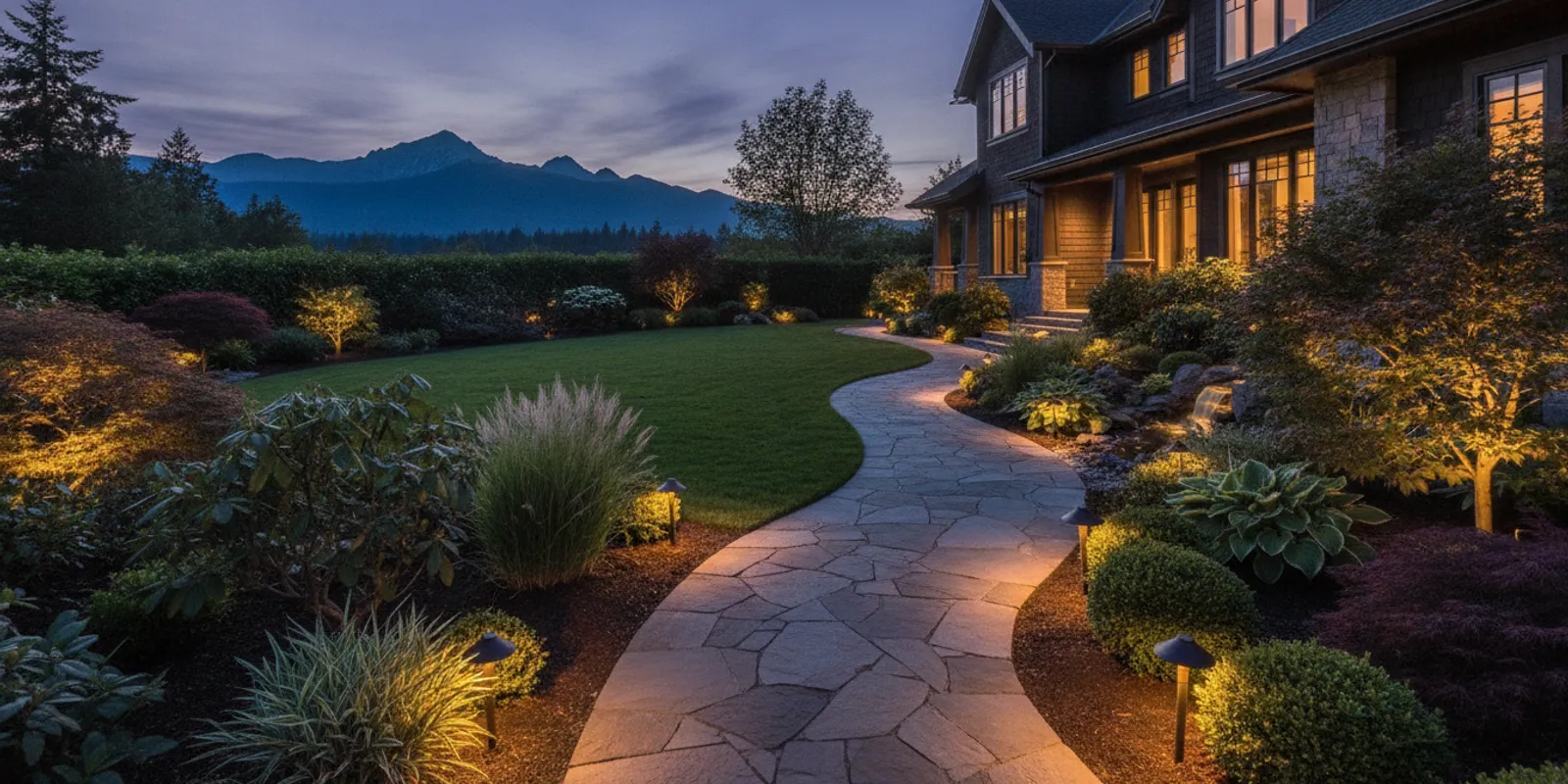
Choosing between landscape lighting vs solar lighting starts with the job you want the light to do. A few solar fixtures can add a modest glow without wiring, while a professionally designed low-voltage system can coordinate multiple areas, controls and fixture locations across a property. Neither option is right for every yard. Oregon homeowners, estate owners and property managers should weigh the amount of light needed, available sun, seasonal conditions, desired control and willingness to maintain individual fixtures.
Request a complimentary lighting consultation
What is the difference between landscape and solar lighting?
Solar lighting describes how a fixture gets its power: a small photovoltaic panel charges a battery, which then powers the light after dark. Many standalone solar fixtures combine the panel, battery and LED in one unit. They are often placed along paths, in planting beds or near an entry without a connection to a larger lighting system. The term identifies a power source, not a complete design approach or a guarantee of how bright, long-lasting or controllable a fixture will be.
Professionally designed landscape lighting is a broader project, not just a different fixture. A designer considers the property as a whole, selects and positions fixtures for specific features, plans wiring and controls, and coordinates installation. Low-voltage systems typically use a transformer to supply power to fixtures through low-voltage wiring. The final design may include several fixture types and lighting zones. The system is planned around the property, its access and the desired scenes.
These categories are not always opposites. A property can use a wired system for key areas and a few self-contained solar lights where a small, independent accent is appropriate. The useful comparison is whether each approach can meet the particular need reliably and with a level of upkeep the owner accepts. If someone says “solar versus landscape lighting,” ask what they mean by landscape lighting: one low-voltage fixture, a coordinated installation, or a broader design-and-service project. The scope changes the comparison.
For this guide, “wired landscape lighting” means a professionally planned low-voltage system. It does not mean every fixture must be wired, nor that a solar product cannot be part of a thoughtful landscape. The distinction is useful because a networked plan has different design, installation and control considerations from a set of standalone products.
Which lighting job are you trying to accomplish?
Start with the purpose, not the product. Make a short list of the places that matter after dark and what you want to see there. A front path, a mature tree, an outdoor dining area and a long driveway do not present the same design problem. Nor does a homeowner who wants two small decorative accents have the same scope as an HOA coordinating common areas.
- Path and entry: Decide whether the goal is a gentle visual guide, a more defined entry scene or continuity across several walking routes. Consider fixture placement, glare and how the lights relate to steps, doors and planting.
- Landscape features: Identify trees, garden beds, walls, water features or architectural details you want to bring into the evening view. A lighting plan can consider how several elements work together rather than treating each fixture as a separate purchase.
- Outdoor living: Think about how people use patios, seating areas and circulation routes. Note where a quiet background glow is enough and where a more deliberate lighting layer is desired.
- Long or complex sites: Mark the areas, distances and access constraints. A larger estate, commercial property or managed community may need a coordinated plan and clear division into zones.
Then ask how often the lights need to work as intended. If a fixture is mainly decorative and occasional variation is acceptable, a simple solar option may be reasonable. If the property owner expects coordinated lighting across several important areas on a regular schedule, a professionally planned system may be a better subject for a consultation.
It helps to separate “must work” locations from “nice to have” locations. For example, a homeowner might prioritize the route from the driveway to the front door, then consider a small accent on a specimen tree as an optional addition. A restaurant or hospitality manager might first identify the guest approach and outdoor seating, then decide whether a secondary garden area belongs in the same phase. This order prevents the discussion from becoming a tally of fixture counts before the purpose is clear.
Write down the observation rather than prescribing a fixture. “The steps disappear from the path after sunset” is more useful than “I need three solar lights.” “The back garden feels disconnected from the patio” gives a designer room to discuss placement and layers. You can still compare a particular solar unit, but first define the outcome you want to evaluate.
How does consistency differ?
Solar fixtures depend on the light reaching their panels and on the condition and capacity of their batteries. A shaded location, a panel covered by debris, changing daylight or a battery that has aged can affect how long a fixture operates after dark. Units in different parts of a property may receive very different amounts of sun, so their output and operating time may not match from one location to another.
That does not mean every solar light will perform poorly, or that every wired installation will be trouble-free. It means the power arrangement introduces different variables. A solar fixture is most predictable when its panel has suitable exposure and the owner checks the unit periodically. A low-voltage design relies on its power supply, wiring, connections, fixtures and controls being properly specified and maintained. The consistency question is therefore about matching the system to the site and keeping its components in working order.
Oregon properties can have tree cover, roof overhangs, cloudy periods and wet seasons. The exact effect varies by location and placement, so do not assume that every yard receives the same useful sun. Observe the proposed fixture spots at different times of day. If the panel area is shaded for much of the day, ask whether a solar fixture is a sensible choice there. For wired lighting, ask how the design accounts for the route, existing hardscape and planting, and how the system will be checked if a zone stops working.
On a large property, consistency also means visual consistency. A group of unrelated standalone fixtures can vary in brightness, color appearance, spacing and style. A designed system can coordinate fixtures and scenes across areas, though the final result depends on the selected equipment and installation. Ask to see how the proposal groups the lighting and what each group is meant to accomplish.
A practical test is to stand at the place where someone will experience the light. For a path, look from the approach and from the doorway, not only directly beside each fixture. For a garden feature, view it from the patio or a principal window. Note whether individual points seem balanced or whether one light becomes the only thing you notice. A standalone solar product may be suitable for a modest point of interest, yet the same product repeated every few feet may create a different visual effect. A system plan can address spacing and relationships, but the owner should still review the proposed intent rather than assume that “more fixtures” means a better result.
Also distinguish consistency in appearance from consistency in operating time. A row of fixtures can look coordinated when first installed but still behave differently if some panels receive less sun. If comparing solar units, place one or two samples in the intended locations and observe them over multiple evenings, including after a cloudy day if practical. Record when each turns on and how it looks from the key viewpoint. This will not predict every seasonal condition, but it gives you a more useful basis than judging a fixture straight out of its packaging.
Where can each type be placed?
Standalone solar fixtures have a practical advantage when installation needs to stay simple. Many can be moved without trenching or connecting them to a central power supply. That can suit a small garden accent, a temporary experiment or a location where adding wiring would not make sense. The panel still needs a suitable place to receive daylight, and the fixture needs to be positioned so it illuminates the intended area rather than shining into a window or becoming an obstruction.
Low-voltage landscape lighting offers more flexibility when a plan needs to connect different features or place fixtures where sunlight is limited. Wiring can serve locations under tree canopies or near covered entries, subject to the system design and installation conditions. A professional plan can also coordinate paths, planting beds, architectural features and outdoor living spaces. That flexibility does not mean every location is easy or that wires can be routed anywhere without regard to access, existing surfaces or property care.
Placement has both a visual and a practical side. A light that is easy to install may still be poorly aimed, too prominent during the day or difficult to maintain. A fixture hidden in foliage might be hard to reach later. Wiring routes can encounter roots, paving, irrigation or other site features. Before installation, discuss how the crew will access the work areas and protect planting beds, paths and hardscape. Ask which surfaces or garden areas need to be disturbed, how they will be treated during the work and what restoration is included in the written scope.
For a broader look at fixture positions along paths, see CLG’s Oregon pathway lighting guide. Use it to identify walking routes and landscape features you want to discuss without assuming that one fixture layout fits every property.
Think through placement in three layers. First, mark where light is needed: a turn, a change in level, an entry or a feature. Second, mark places where a fixture or panel could realistically sit without interfering with planting, mowing, foot traffic or maintenance. Third, consider what the source will look like from the viewpoints that matter. The best location for a solar panel may not be the best location for the light itself, especially if the product has a separate panel. For a low-voltage plan, the preferred lighting location still has to work with the wiring route and site conditions.
Established gardens need particular care. Ask whether plants are likely to conceal a fixture as they grow, whether routine pruning can expose it, and whether future digging could intersect a cable. If a property has irrigation, drainage features, retaining walls or mature roots, identify them before project planning. No simple map will capture every underground condition, but sharing what you know can help make the scope more realistic. A manager of a multi-unit site should also point out restricted areas and specify who can approve work near shared paths or landscaping.
What can you control?
Control needs range from a single on-and-off action to a set of zones with schedules or programmed scenes. Many solar fixtures have controls built into the unit, such as an automatic dusk response or a simple switch. Features vary by product. If you are considering solar, check what the fixture actually allows: whether it has a manual setting, how it responds to darkness and whether its operating mode can be adjusted. Do not assume that a low-cost-looking fixture has a particular sensor or schedule feature.
A planned low-voltage system can be designed with controls suited to the installation. Depending on the selected equipment and project, that may include a timer or separate zones. Ask which functions are included in the proposed system, how settings are changed and who will explain them at handoff. Where app control is part of the specified equipment, confirm that the app and controller support the scenes and schedules you have in mind. Control features are not automatic consequences of choosing wired lighting; they must be part of the actual design and proposal.
For a homeowner, useful control questions might include:
- Can the entry and the garden operate separately?
- Can schedules change by season, or will someone need to adjust them manually?
- Can a scene be dimmed or changed for a gathering?
- What happens after a power interruption or controller reset?
- Who demonstrates the settings and provides support if the controls are confusing?
For a commercial, hospitality or multi-property site, control discussions may include who is authorized to change settings and whether different areas have distinct operating needs. A written proposal should distinguish included functions from optional features. Avoid paying for controls no one intends to use, but do not assume a collection of independent solar fixtures can provide the coordinated operation that a managed site requires.
Try describing a normal evening in sequence. When should the entry come on? Does the patio need a different schedule from a front garden? Should a manager be able to switch a zone off for maintenance without changing every other area? These questions reveal whether a single built-in sensor is enough or whether a more deliberate control arrangement is worth discussing. They also help prevent a proposal from adding functions that sound attractive but do not solve a real operating need.
For an estate, separate zones can reflect how different parts of the property are used, but each added control point can add setup and explanation. For a smaller home, a simple schedule may be easier to live with than several scenes. A property manager should identify who will receive the instructions when staff changes. If a feature depends on a particular controller or app, record the model and the steps needed to operate it. The decision should consider ease of handoff, not only the initial demonstration.
How do maintenance needs compare?
Solar fixtures are independent units, so care often happens one light at a time. A property owner may need to clear debris from panels, inspect fixtures after weather, check batteries and replace a unit or component when it no longer performs as expected. Small units can be straightforward to swap, but a property with many fixtures can turn repeated checks into a substantial chore. Battery replacement may depend on the product design and availability of compatible parts.
A wired landscape system has a different maintenance profile. It can require attention to fixtures, lamps or LEDs, wiring connections, transformer settings, timers and controls. A fault may affect one fixture, a circuit or a zone, so diagnosing the cause can take more than replacing a visible light. The advantage of a coordinated system is not that maintenance disappears; it is that the installation can be planned as a system and supported through service. Ask what ongoing checks, repairs or adjustments are available, and what is included versus quoted separately.
Consider how easy each location will be to reach in wet or overgrown conditions. A panel located among dense planting may need frequent cleaning. A fixture placed beside a path may be exposed to foot traffic or garden work. Buried wiring needs to be considered before digging or changing a bed. Keep any plans, zone labels and control instructions that come with an installation, and share them with future landscapers or property managers.
CLG describes maintenance and repair support as part of its service offering, including troubleshooting and system repair. The exact work, timing and cost depend on the issue and the written service scope. Do not treat a general service description as a promise of a particular response time or as blanket coverage for every component. Ask for the current terms and clarify how service requests are handled before you approve a project.
A basic maintenance plan can be as simple as a short seasonal walk-through. For solar, check whether panels are clear, fixtures remain upright and each unit operates as expected. For a wired system, look for fixtures shifted by garden work, foliage blocking the intended beam, visible damage and control settings that no longer match how the space is used. These observations do not replace diagnosis of an electrical issue. They help you notice a change and describe it accurately when asking for service.
For a property with many independent solar fixtures, decide who owns the routine. A homeowner may be comfortable checking a few lights, while an HOA could need a named maintenance contact and a record of which fixtures have been replaced. If a wired system is installed, retain its layout and control information in a place accessible to whoever manages the grounds. When landscaping changes, tell the person doing the work where wiring is believed to run; do not rely on a memory of fixture locations alone.
Ask what happens when a light stops working. With a standalone unit, can the owner identify the product and source a compatible replacement? With a designed system, who should inspect a failed fixture or zone, and is troubleshooting available under a defined service arrangement? Do not assume that all repairs are included in installation or that every product can be repaired rather than replaced. Clear answers make the ongoing effort easier to compare.
What do Oregon weather and site conditions change?
Weather does not make one lighting type universally right. It changes the questions worth asking. Rain, wind, fallen leaves, plant growth and seasonal daylight can affect access, panel exposure and the amount of attention a system needs. In a high-desert setting, sun and heat exposure may be different from a shaded, tree-lined yard in the Willamette Valley. A property in Bend, Eugene or Salem can still have its own microclimate and site constraints.
For solar units, think about the panel as well as the light. Will it receive useful daylight through the year? Could leaves, moss, snow or debris collect on it? Is it easy to reach for cleaning without stepping into a planting bed or onto a roof? If the panel is separate from the light, will its position and cable be practical for the site? Ask the manufacturer or seller about the fixture’s stated outdoor-use requirements rather than assuming all products tolerate the same conditions.
For a wired plan, talk through where cables and fixtures will go in relation to wet ground, existing irrigation, roots, paving and planned garden changes. Ask how the installer selects equipment for the intended location and what service access will remain after the planting matures. The aim is not to promise that weather cannot affect a system. It is to choose an appropriate scope, understand its care needs and avoid burying important assumptions in a verbal conversation.
Property care matters during installation too. A design may call for access across a lawn, a narrow side yard, a steep slope or established beds. Tell the lighting team about delicate plantings, irrigation lines, drainage concerns, gates, pets and areas that should not be disturbed. For managed properties, name the person who can approve access and identify any rules for work hours, common areas or tenant communication. Those details can influence the practical plan as much as the fixture choice.
Seasonal conditions can also change the appearance of a location. Planting that is dense in summer may thin out in winter. A path edge that is easy to see in dry weather may look different when wet or covered in leaves. When you evaluate placement, look at the site in more than one season if you can, or explain how the garden changes during the year. The design conversation should account for mature growth and routine maintenance rather than treating the current view as permanent.
Ask how the project team will keep the installation practical for the people who care for the property. A fixture should not be placed where routine mowing repeatedly catches it, and an accessible solar panel should not require stepping over delicate plants every time it needs attention. On a managed site, consider whether grounds staff can reach fixtures without special access and whether they know which controls serve which area. A plan that respects ordinary property care is easier to maintain than one that assumes the landscape will never change.
How should you compare project scope and cost?
A standalone solar fixture is often purchased as an individual product or small group, while a professional landscape-lighting project includes planning and installation. Comparing only the fixture price can hide the difference in work and outcomes. A fair comparison asks what is included, how much of the property is addressed, what controls are supplied and what support follows installation.
CLG’s published planning range for landscape lighting is $5,000–$50,000+. This is an indicative range, not a price for every project. Scope, property, fixtures, access, controls, wiring and service details determine the final itemized proposal. A small, focused plan and a multi-area property design may be very different projects even if both are described as landscape lighting.
When gathering options, compare these components:
- Design scope: Which areas and features are included? Are priorities and exclusions named?
- Equipment: What fixtures, light sources, power components and controls are specified? Are models and quantities listed?
- Installation: What wiring routes and access work are expected? What happens to planting, lawn, paving and other affected areas?
- Operation: What schedules, zones or app functions are included, if any? Who configures and explains them?
- Support: What maintenance or repair options are available, and what are the applicable written terms?
- Payment: Is the amount an indicative planning figure or a property-specific proposal? If financing is discussed, what current terms apply?
CLG advertises an application option through the Synchrony Home Design Credit Card. Financing is subject to application and approval, and promotional terms can change. Review the current written terms directly before making a decision; do not assume a particular approval, rate or promotion.
For a more detailed comparison of the way landscape and permanent architectural lighting costs are framed, see Oregon lighting costs and project factors. Permanent architectural lighting is a separate service line from landscape lighting, so it should not be used as a direct substitute for a quote on a garden or path project.
A useful comparison starts with equal scope. If a solar option includes four independent fixtures for one path, compare it with a wired proposal for that same path before comparing it with an entire property plan. Then, if desired, consider what it would cost to extend either approach to the entry, patio or trees. This two-step comparison keeps a limited product purchase from being measured against a much broader project as though they were interchangeable.
Next, separate first cost from the work that continues after installation. For solar, list the product purchase, any replacements and the time needed to check panels or batteries. For a professional system, list the written installation proposal, any optional controls, and the maintenance or repair terms you have been given. No single calculation will fit every property, and future replacements or service needs cannot be known precisely from the category alone. Still, writing the assumptions down makes the trade-offs visible.
For example, imagine an owner comparing a few lights for a sunny front garden with a plan for a path, entry and several landscape features. The first choice may require little setup and address only the garden accent. The second is a different scope and should be compared as such. Ask whether a phased design is possible: perhaps the initial work covers the path and entry, with other areas considered later. A staged project should still have a clear first-phase boundary so that future work does not depend on assumptions that were never recorded.
Do not treat an indicative planning range as a quote, and do not assume that a low initial purchase cost settles the total effort. A proposal should identify what it covers and which site conditions might change the work. If a financing option is relevant, review the application terms and promotional details in writing. The decision is not simply “cheap versus expensive”; it is whether the amount corresponds to a clear scope and an acceptable level of ownership effort.
When might solar lighting be a reasonable fit?
Solar may suit a modest, limited-purpose installation when the site has good panel exposure and the owner accepts that performance can vary with conditions and product design. It can be useful for trying a location before committing to a more coordinated project, adding a small decorative point of light or illuminating a spot where independent placement is preferable. The fixture should be treated as a specific product with specific capabilities, not as a guaranteed way to light an entire property.
It may be less suitable when a key area has persistent shade, when many lights need to match, when schedules or separate zones matter, or when the owner expects consistent operation across a large site without regular checks. Those are not absolute prohibitions. A carefully selected solar product can meet a particular need, but the decision should account for the location and the level of performance the owner expects.
Before buying several units, test one in the intended location if practical. Observe its appearance after dark over more than one evening and note panel exposure during daylight. Check whether its light is visible from the viewpoints that matter and whether the fixture fits the landscape during the day. Read the product instructions for charging, battery care, operating modes and outdoor limitations. A small trial can reveal a mismatch before it is repeated throughout the property.
Use a simple trial log. Record the fixture model, location, approximate sunlight or shade, the time it comes on and how it looks from the path or window you care about. Check whether rain or garden debris changes the condition of the panel, and note whether the fixture is easy to clean. The goal is not a laboratory test. It is to learn whether the product fits the actual site and your tolerance for checking it.
Solar is often easiest to evaluate when the need is isolated: one garden corner, a small bed or a spot where adding wiring would be disproportionate to the purpose. Be more cautious about purchasing a large set before trying the product. A dozen individually placed fixtures can create a different visual rhythm from a few accents, and replacing mismatched products later may be more work than changing the initial plan. Buy to the observed need, not simply to the number of fixtures in a package.
Before deciding, check the product documentation for how the panel and battery are handled, whether a battery can be replaced, how the product is intended to be installed and what outdoor conditions it is designed for. Features differ by product. Ask the seller a specific question rather than relying on a broad label such as “all weather” or “long lasting.” If the instructions are unclear, treat that uncertainty as part of the purchasing decision.
When should you discuss a professionally designed system?
A consultation is worth considering when the project spans several property features, needs a coordinated look, includes locations that do not receive direct sun, or calls for controls and support beyond individual fixtures. The same is true when the property has existing lighting that needs troubleshooting or expansion. A designer can help define a practical scope and identify site questions that should be answered before installation.
CLG’s landscape service is presented as a property-specific design and installation process. The company’s published material describes a complimentary estimate and a written proposal, with the details depending on the project. During the conversation, explain your priorities, how the property is used after dark and what maintenance you are willing to handle. Bring a simple site sketch or photos if available, and mark the areas that are must-haves versus optional.
Helpful preparation includes:
- List the routes, entries and landscape features you want to address.
- Note where existing outlets, irrigation, paving, trees and other constraints are located, if known.
- Describe desired operating times and whether separate zones or scene changes matter.
- Identify who will maintain the garden and who will control the lighting.
- Set an approximate project scope or planning range, while recognizing the final proposal depends on the property.
- Ask what installation will disturb and how the team plans to protect the site.
- Request written clarification of equipment, controls, service options and any warranty terms.
For Bend-area property owners, the Bend outdoor lighting information is a starting point for discussing local project needs. Service coverage and project suitability should be confirmed for the specific address rather than assumed from a general service-area page.
There is no need to arrive with a finished lighting plan. A useful consultation can begin with observations: where people walk, what areas are used after dusk, what the property owner wants to highlight, and what should remain understated. Add practical constraints, such as access gates, planting beds that need protection or changes planned for the garden. A human-reviewed proposal can then identify the proposed scope and the assumptions behind it.
Ask for the proposal to distinguish included work from options. If the plan includes several zones, ask what each zone serves and how it is operated. If a fixture or control is an alternate, ask what changes if it is omitted. If installation depends on access or a site condition, ask how that assumption is handled. These questions help you compare the proposal with a solar alternative without treating every project component as a mandatory upgrade.
After reviewing the scope, take time to check the plan against daily use. Would the controls be simple enough for the person responsible? Can maintenance staff find the relevant equipment? Does the installation route respect areas that need special care? If an optional area is deferred, does the current phase still function as intended? A short review before approval can surface questions while the scope can still be clarified.
How can homeowners and managers make a balanced choice?
There is no universal winner in the landscape lighting vs solar lighting comparison. The choice depends on the number of locations, desired consistency, access to sunlight, control needs and expected upkeep. A standalone fixture can be the simpler answer for a small, sun-exposed accent. A designed low-voltage installation can address a broader set of property goals when wiring, fixture coordination and ongoing support matter.
Homeowners can begin with one priority, such as a path or a garden feature, rather than trying to light everything at once. Estate owners may want to consider how distant areas connect visually and whether a phased plan can preserve a coherent design. Commercial and hospitality managers should identify operating responsibilities, access requirements and the people who will maintain and control each zone. HOAs and multi-property managers can benefit from defining repeatable standards while allowing for differences in each site’s layout.
For any type of project, ask for clarity on what is and is not being promised. A proposal should be specific enough to show the work, locations, equipment and controls under consideration. It should explain assumptions about access and property conditions. If a feature depends on a certain product or site condition, ask how that affects operation and service. A careful discussion of limits is part of making an informed decision, not a reason to expect a particular result.
One useful way to decide is to assign each area to one of three categories: a location where dependable, coordinated operation is important; a location where a simple accent is enough; and a location that can wait. That list often leads to a sensible combination. The main path or entry might be part of a planned system, while a sunny decorative corner remains a standalone experiment. Another property might have only a couple of easily reached garden accents and no reason to plan a larger installation.
For owners who manage several properties, avoid assuming that one template fits every site. A consistent process can still ask the same questions—purpose, access, control, maintenance and scope—while the answer varies by property. A shaded estate garden may need a different power approach from an open courtyard. A commercial property may need a clear operator for schedules, while a private home may need only one simple routine. Document the decision in terms of the site instead of relying on a general rule about either technology.
Be wary of deciding on a large project from a single daytime photo or of deciding on a product solely by package quantity. Visit the site after dark where possible, identify the viewpoint that matters and consider whether the proposed amount of light fits the use. If an approach is not meeting the intended purpose, make a note of what is missing—placement, uniformity, control, reach or maintenance—before changing the system. A precise description is more helpful than assuming that adding more fixtures will solve every problem.
What should you ask before choosing?
Use these questions to turn a broad product comparison into a decision about your own site:
- Which areas need dependable, coordinated lighting, and which can remain simple accents?
- Do the proposed solar panel locations receive suitable daylight through the seasons?
- Will standalone fixtures match one another in appearance and operation?
- Do I need separate zones, schedules, dimming or app-based control?
- What maintenance will I do myself, and what service can I request?
- Could installation affect beds, paving, irrigation or mature roots?
- What exact equipment, installation work and support does the written scope include?
- How will the system be demonstrated, and who can answer questions after handoff?
Make the questions concrete by naming the location. “Will solar work?” is difficult to answer without knowing whether the panel is shaded, how often the light is needed and what performance is acceptable. “Can this fixture location receive daylight through the year, and how would I check its condition?” leads to a practical product discussion. Similarly, “Will wired lighting work?” is less useful than asking how a proposed route crosses a particular lawn, bed or paved area.
Request an itemized description rather than comparing broad labels. For a solar purchase, note the fixture and panel configuration, product instructions, expected operating mode and replacement approach. For a designed system, note areas, fixture types, wiring and control assumptions, installation work and available support. Keep the comparison focused on the same locations and desired use. If one proposal covers more, identify that difference before comparing totals.
Ask who will make decisions during installation and who receives the operating instructions afterward. For an owner-occupied home those may be the same person. In a business, HOA or managed estate, they may be different. Write down the name or role of the person responsible for routine checks and for requesting help. This small administrative step can prevent a system from becoming confusing when property responsibilities change.
Answers may point to a simple solar purchase, a professionally designed plan or a combination. The important distinction is whether the chosen approach matches the property’s actual constraints and the owner’s expectations, rather than relying on a general claim that one kind of lighting always performs better.
Frequently asked questions about landscape and solar lighting
Can solar fixtures be mixed with wired landscape lighting?
Yes, they can be considered together when each serves a suitable purpose. For example, a planned system might address a main path and key landscape features while an independent solar fixture serves a small accent. Think about whether their appearance, operating times and maintenance needs will work together. Confirm product placement and the designed system scope before purchasing or installing both.
Do solar lights work in Oregon?
They can work where the selected product receives enough daylight for its intended use, but results depend on the fixture, panel exposure, battery condition and weather. Oregon has varied sites and seasonal conditions, so the answer for a sunny, open spot may differ from a shaded garden under mature trees. Check the product’s instructions and observe the specific location rather than assuming a statewide result.
Does low-voltage mean the system needs no maintenance?
No. Low-voltage landscape systems still have fixtures, wiring, power equipment and controls that may need inspection, adjustment or repair. Their maintenance needs differ from those of standalone solar lights. Ask which service is available and what the written terms cover.
Will a professionally designed system always cost less over time?
That cannot be determined from the lighting type alone. Initial scope, product selection, replacement needs, maintenance, installation conditions and how the owner uses the system all affect the comparison. Request a property-specific proposal and compare its included work with the products and upkeep required for the alternative.
Can I get a quote without knowing exactly what I want?
Yes. A consultation can help establish priorities and identify the appropriate scope. Describe the areas you notice after dark, what you would like to change and any site concerns. The final recommendation and itemized proposal should reflect the property and the agreed project details.
Talk through the right lighting scope
If you are weighing a few independent fixtures against a coordinated landscape plan, start by describing the locations, conditions and controls that matter to you. A property-specific discussion can clarify what belongs in the scope and what questions need answers before work begins.
Discuss your property and request an estimate
The right choice is the one that fits the site, the desired experience after dark and the level of maintenance and control you are prepared to manage.