
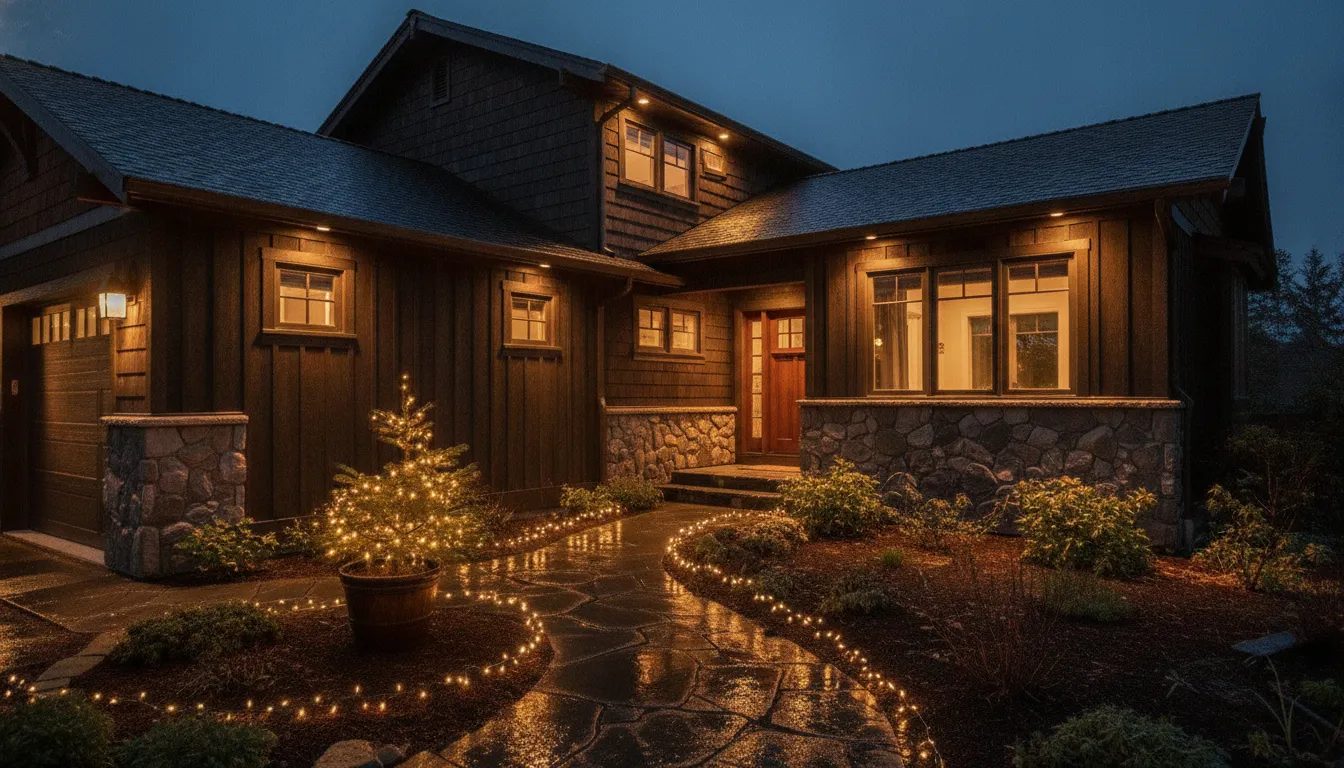
Oregon homes often need lighting to do two different jobs: create a seasonal focal point or add architectural character throughout the year. The right choice depends less on which system looks brighter and more on how you want to use, maintain, and budget for the property.
Request a complimentary lighting estimate
With permanent lighting vs holiday lighting, the central choice is year-round equipment versus a managed seasonal display. Permanent architectural lighting stays installed along the roofline and can be adjusted with app-based colors, patterns, brightness, and schedules. Professional holiday lighting is designed for a defined season, with installation, in-season maintenance, takedown, and storage handled as part of the service. A permanent system generally involves a larger upfront investment, while seasonal lighting offers a recurring service model. Your property, scope, access, and preferred level of involvement shape the proposal.
Before comparing installation and upkeep, it helps to understand what permanent architectural lighting is built to accomplish. Its track, controls, and placement follow the lines of the home, supporting everyday curb appeal and celebrations without looking temporary.
What Permanent Architectural Lighting Is Designed to Do
A seasonal display goes up for a few weeks and then comes down. Permanent architectural lighting is built to stay part of the property all year. CLG uses a color-matched aluminum track that can follow a roofline, soffit, or fascia. In daylight, the system is intended to blend with the home’s exterior rather than look like temporary holiday equipment.
Each LED is individually addressable, so the system can create more than one fixed look. Through the app, homeowners can select colors, adjust brightness, build scenes, and set schedules. That makes it possible to use a subtle setting for ordinary evenings, then change the appearance for a gathering, holiday, sporting event, or other occasion without rehanging lights.
CLG publishes the Gemstone system with more than 16 million color options, a 50,000-hour LED rating, and an IP67 rating. These are published product specifications and should be understood as product messaging, not a promise of zero maintenance or lifetime labor. Components, controls, wiring, and the surrounding property still affect how a system performs and what support it may need over time.
The practical distinction in permanent lighting vs holiday lighting is the type of service and commitment involved. A permanent system is installed as a property feature for everyday use as well as events. Seasonal holiday lighting is a temporary display managed for a particular season. If you are considering a year-round system, review CLG’s permanent architectural lighting service to see how the design is matched to the property.
CLG publishes an indicative investment range of $2,500 to $10,000 or more for permanent architectural lighting. That range is not a fixed package price. The final proposal depends on the property, track length, access, controls, wiring, and project scope. A property-specific assessment is the appropriate way to determine the layout, equipment, and total investment for a particular home or commercial site.
What Seasonal Holiday Lighting Is Designed to Do
Professional holiday lighting is a managed seasonal program, not a one-time delivery of lights. The team develops a temporary design around the property, then handles the work needed to put that design in place and keep it looking consistent through the season. The scope can be residential or commercial, depending on the property and the goals for the display.
Design typically considers the roofline, peaks, trees, paths, entry points, and other features that shape how the property is seen from the street. The goal is a balanced display that fits the architecture and the way people approach the property. A professional holiday lighting plan can cover a focused entry or a broader arrangement across the exterior.
Once the design is approved, installation is part of the service. In-season attention is also part of the managed approach, with availability and exact terms confirmed in the proposal. At the end of the season, the lights are taken down rather than left as a permanent installation. The service then includes off-season storage as described in the proposal.
This temporary cycle is the clearest distinction when comparing permanent lighting vs holiday lighting. Seasonal lighting is installed for a defined period and removed afterward. Permanent architectural lighting is integrated into the property, so it is designed for ongoing use rather than annual installation, takedown, and storage. Each approach solves a different practical and design need.
CLG publishes professional holiday lighting starting at $1,000, but that is not a fixed quote. Property details and the selected scope determine the final proposal. It is also common to discuss planning in September or October because holiday schedules can fill, particularly before Thanksgiving. That timing is guidance, not a guaranteed booking slot, so availability should be confirmed directly.
Which Lighting Job You Are Actually Hiring
People search permanent lighting vs holiday lighting because the two can look similar in a December photo. At night, both can trace a roof. In March, only one of them is still there, and only one of them was built to be.
Hire permanent architectural lighting when the job is the building itself. You want the eaves, fascia, and main lines to read after dark on a Tuesday, not only on Christmas week. You also want to change that look without a crew coming back. A dinner, a game, or a quiet warm-white evening can each have its own scene.
Hire seasonal holiday lighting when the job is the season. You want trees, peaks, and an entry dressed for a few weeks, then gone. You do not want to store bins, test strands, or send someone up a ladder. The value is the managed program, not a piece of equipment you own and program.
A third case is easy to miss. Landscape lighting is neither of these. Path lights, tree uplights, and garden accents live in the yard, not on a holiday calendar and not in a roofline track. If the question is really about the garden, start with landscape lighting instead of forcing it into this comparison.
Permanent Lighting vs Holiday Lighting on Controls and Timing
One system stays on the building and changes from an app. The other arrives for a season and leaves with the crew. That is the practical split.
| Decision point | Permanent architectural lighting | Seasonal holiday lighting |
|---|---|---|
| What stays on the property | Color-matched track and LEDs remain installed. | The display is temporary and comes down after the season. |
| When you use it | Ordinary evenings, events, and holiday scenes. | A defined holiday season. |
| Controls | App scenes, colors, brightness, and schedules. | The design is set for that season’s display. |
| Installation pattern | Installed once as part of the architecture. | Installed for the season, then removed. |
| Storage | No seasonal storage of the track system. | The service includes takedown and off-season storage. |
| Planning figure | About $2,500 to $10,000 or more. | Starts at $1,000. |
Both figures are published planning ranges, not online prices. A written proposal uses the property, access, controls, wiring, and scope. Do not treat either number as the cost of every Oregon home.
Day to day, the experiences diverge. With a permanent system, you live with the light and change it yourself. With a holiday program, you book a season. The team handles the ladders, the display, and the storage.
How to Read the Planning Prices
Price questions come up in almost every CLG consultation, and they are fair. They are also easy to answer badly. A seasonal display and a permanent track are not two bids for the same line item.
The holiday figure, starting at $1,000, is an entry point for a managed season. It does not list every decoration, replacement, or extra visit. A small, simple home display and a multi-story commercial front will not land on the same proposal. Renewal, if you want the program again next year, is its own conversation.
The permanent range, about $2,500 to $10,000 or more, is a typical project investment for a Gemstone installation. It is not a price per foot, and it is not a promise that every home fits inside it. Track length, roof access, controls, and wiring move the number. A longer or more complex roofline can sit above the range.
Compare them on the job you want repeated. One season of holiday service can cost less this year. A permanent system is paid as an installation you keep using. CLG does not publish a savings claim, an energy comparison, or a payback period, so this article will not invent one.
Financing, when someone wants it, is an application. It is not a discount and not an approval. The written proposal still has to make sense before a payment plan does.
How Property Scope and Service Support Differ
Support follows the product. A permanent system is commissioned, handed off, and serviced later if something needs attention. A holiday program is a season of work that includes the ending, not only the install night.
- Permanent work includes design, track installation, and an app walkthrough.
- Later permanent help can include service or a retrofit, quoted on its own.
- Holiday support includes in-season attention, then takedown and storage.
- Holiday response times and extra visits belong in the written agreement.
Homes, estates, retail fronts, and HOA properties can all be in scope. None of them comes as a fixed package. A larger site may need more zones, more access planning, or a longer install. The proposal should say which of those apply.
CLG does not publish a maintenance-plan price or a lifetime repair contract for permanent lighting. Product ratings are not a promise that nothing will ever need service. For a plain look at upkeep across outdoor lighting, see outdoor lighting maintenance and support.
The shared path is still a consultation, a property-specific design, installation, and a walkthrough. The design and installation process explains those stages without locking you into one service line.
What Oregon Weather Changes About the Choice
Western Oregon rain, coast wind, and Central Oregon cold are not the same test. Both services are built around exterior equipment, but they meet weather in different ways.
A permanent track is specified for year-round exposure. CLG describes weather-resistant components and an IP67 rating on the Gemstone system. That rating is a product specification for dust and water. It is not a claim that a given roof, outlet, or connection will never need a service visit. Debris, ice, and a curious branch still happen.
A holiday display is only outside for the season, which limits how long wind and rain can work on it. The tradeoff is timing. A wet November week can slow an install. A wind event during the season is why in-season service is part of the program. Storage matters too, because strands that sit in a damp garage can start the next year already tired. CLG’s program includes off-season storage so that step is not left to the property.
None of this is a blanket code or safety certificate. Mounting, power, and any permit question belong in the proposal for that address. If you want the install sequence for a permanent system, that lives in the permanent architectural lighting installation guide, not in this comparison.
Questions to Answer Before You Choose
The useful version of permanent lighting vs holiday lighting is a property question, not a brand contest. Start with how you actually use the outside of the building after dark.
- Do you want light only for the holidays, or on ordinary nights too?
- Do you want hardware to stay on the house between seasons?
- Who should handle ladders, storage, and the seasonal labor?
- How many seasons do you expect to repeat a similar display?
- Do you want simple holiday lines, or scenes you can change?
- Are you comparing a one-season service with a multi-year installed system?
Neither answer is automatically better. A family that loves a classic December look, and does not care about roofline light in July, may be well served by a seasonal program. A homeowner who wants evening scenes all year is looking at a different product.
Some properties use both. Permanent architectural light can stay on the roofline, while a seasonal display still goes in trees or along a walk. That is a design choice, not a requirement. If you already lean toward a year-round system, permanent lighting for every season covers scene ideas after that choice is made.
When a Property Should Use Both
Choosing one does not ban the other. The clean split is architectural light versus a seasonal display in the landscape.
A permanent track is good at the lines of the house. It is a poor substitute for a lit tree, a wrapped entry garland, or a commercial window display that should disappear in January. Those pieces are still holiday work. Leaving them to a permanent system usually means either skipping them or asking the track to do a job it was not designed for.
The reverse is also true. Rehanging a full roofline every November is a lot of labor if what you wanted was everyday light. A seasonal crew can still dress the trees after the roofline is already handled.
Say that mix out loud in the consultation. Otherwise the proposal may price only one of the two. Commercial and HOA sites should be especially plain about access, hours, and who approves the look. A single-family home and a retail front do not share a schedule, even when the equipment category is the same.
How to Request the Right CLG Consultation
If you are still comparing the two, say so. The estimate form lets you select more than one service, so you do not have to pretend the decision is finished. A person reviews the request. This is not an instant booking.
CLG publishes a follow-up within one business day. You can also call or text (971) 353-5300, or use the form on the contact page. Posted hours are Monday through Friday, 8:00 AM to 6:00 PM, and Saturday, 9:00 AM to 4:00 PM. Sunday is by appointment.
The written proposal is meant to itemize fixtures, work, timeline, and investment for that property. Ask which service the numbers belong to if both are in the conversation. To start, request a complimentary estimate.
Financing is a separate application for the Synchrony Home Design Credit Card. It can apply to landscape, permanent, and holiday work. Approval is not promised, and promotional terms can change. Read the current notes on lighting project financing before you treat any payment plan as fixed.
Frequently Asked Questions
Is permanent lighting the same as leaving holiday lights up?
No. Permanent architectural lighting is a roofline system designed to stay installed and be controlled through the year. Professional holiday lighting is a temporary display that is installed for the season, then taken down and stored.
Can one property use both?
Yes, when the design calls for it. A permanent track can handle everyday roofline scenes, while a seasonal crew still dresses trees, entries, or a commercial front for the holidays. The proposal should say which parts belong to which service.
Which one costs less?
They are priced differently. Published planning figures put Gemstone permanent lighting at about $2,500 to $10,000 or more, and professional holiday lighting starting at $1,000. Neither figure is a quote. Scope, access, and property details set the written number.
Do permanent lights still need service?
They are built for Pacific Northwest weather, but that is not a promise of zero maintenance. Product ratings, including LED life, describe the equipment. Ask for the written workmanship terms and the current manufacturer coverage before you rely on a warranty phrase.
How soon should I ask about holiday lighting?
CLG encourages early booking because seasonal schedules often fill in September and October, especially before Thanksgiving. That is planning guidance, not a reserved date. A consultation confirms what is still open for your property.
Talk Through the Right Lighting Scope
Bring the property, the season you care about, and whether you want hardware that stays. CLG will sort permanent architectural lighting, seasonal holiday lighting, or a mix of the two in a written proposal.
Request a complimentary consultation or call (971) 353-5300.